Sound Check (UK) - update
This guide applies to the heatpunk.co.uk version of Heatpunk. The information provided here does not apply to heatpunk.ie.
The sound check is part of the Heat Pump task and helps determine whether the planned installation position will generate excessive noise that could disturb neighbouring properties. The results of the sound check will be displayed in the customer proposal and technical reports.
Completing the sound assessment
WhenThe sound assessment is completed in the Plan task. Make sure you createhave a newdesign projectoption youplan willis beselected promptedand toa completeheat thepump sound check when you navigateadded to the heat pump task.project.
ChooseMake sure the correct assessment method issuitableselectedforonyourtheproject.Sources sidebar. See below for guidance on which method to choose.- Click the name of the heat pump you would like to complete the sound assessment for.
- Input the details about the heat pump position and assessment points.
- After selecting the kit you would like to use on the project, the results of the sound check will display on the left hand side of the page below the heat pump and cylinder details.
[gif?]
Then follow these steps:
To edit the details of the sound check click the pencil icon to the top right of the results.
Choosing a method
There are currently two sound assessment calculation methods published by MCS. England's Permitted Development Rights now require you to use the 2025 calculation method which is based on MCS 020 a). Other UK nations, where they have not changed their Permitted Development Rights, may still require you to use the legacy calculation method based on MCS 020. Please contact your local planning authority if you are unsure which method to use.
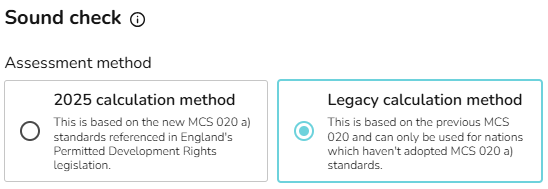
When you start the sound check for your project you can choose between the 2025 calculation method or the legacy calculation method.
Using the 2025 calculation method - MCS 020 a)
To comply with MCS 020 a), the calculated noise level at each assessment position must be below 37 dB. Under MCS 020 a), it is vital to include multiple assessment positions, as more distant locations without a barrier may experience higher noise levels than closer positions that are shielded.
- In order to comply with MCS 020 a) standard, start by selecting the 2025 calculation method.
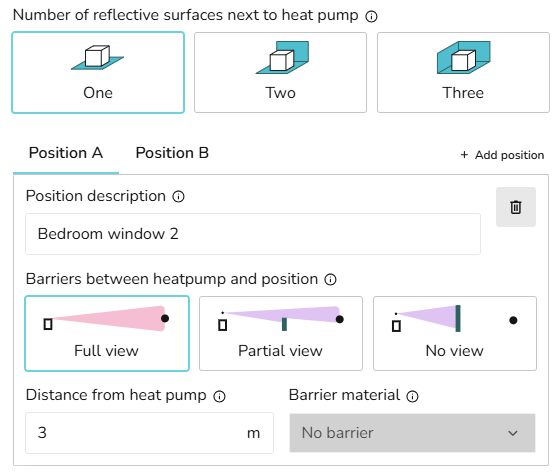
- Select the number of reflective surfaces next to the heat pump.
- Add details for the first assessment position, including the description, distance and details of any barriers.
- Add additional assessment positions by clicking + Add position.
- Delete any positions you no longer need using the dustbin icon.
- Click Confirm to view the sound check results.
See MCS guidelines for further information on the calculation.
Using the legacy calculation method - MCS 020
To comply with the legacy MCS 020 standard, the noise level at a single assessment position must be below 42 dB.
- In order to comply with the previous MCS 020 standards, select the legacy calculation
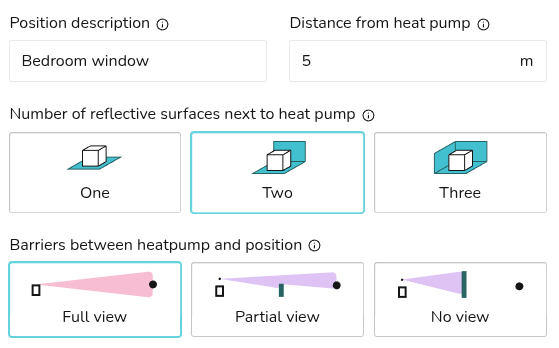
method.method. - Add details for the assessment position, including the description, distance, number of reflective surfaces and details of any barriers.
- Click Confirm to view the sound check results.
See MCS guidelines for further information on the calculation.