
Ventilation Calculations in Heatpunk
WhenThis selectingguide whichprimarily ventilation calculationapplies to use,the UK version of Heatpunk. For the IE version, the Legacy Method (S.R.50-2021) is still the primary method used. Information on the other two available methods can be found below but disclaimers about the Legacy method can be ignored.
Choosing a method
Ventilation calculations are completed at the start of the Heat pump task. In each project will you will have the optionfollowing betweenoptions:
- Standard method
,Measured air permeability(both- based on BS EN 12831-1:2017)2017,andusingtheassumed values for measured air permeability. LegacyMeasuredmethodair permeability - based on(BS EN 12831:2003).MCS requires ventilation heat loss be calculated according toBS EN 12831-1:20172017,(EnergyusingPerformancemeasured values for air permeability.- Legacy calculation - based on BS EN 12831:2003.
Standard method and measured air permeability
When selecting either of Buildings)these methods, you will be prompted to select 'How sheltered from the wind is the building?':

For the Measured air permeability option, you will also be asked to input an air tightness test result:
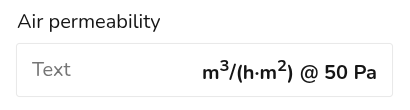
For the Standard method this value is assumed based on the minimum ventilation rate required for the number of bedrooms in the property.
Heatpunk will then execute the calculation detailed below.
Legacy method
If opening a project created before Dec 2025, the Legacy method will be selected. This standardcalculation aims to provideis a moresum accurateof andthe realisticindividual ventilation losses of each room. For each room the following calculation is done:
Room ventilation losses = 0.33 * ACH * Volume * Temperature difference,
where the ACH was taken from Table 3.8 of the CIBSE Domestic Heating Design Guide (2021).
MCS certification in accordance with MIS 3005-D now requires heat loss calculation,calculations generallycomply resultingwith inBS lowerEN 12831-1:2017. Please only select this method when viewing old projects.
Editing selection
If you would like to see which method is being used on a project or alter any inputs, navigate to the Heat pump task. Scroll to the ventilation heatsection losson values.the left-hand side:

Click the pencil to re-open the ventilation losses menu and edit any inputs.
How are ventilation losses calculated?
Under BS EN 12831-1:2017, the ventilation losses for a building are no longernot a simple sum of the ventilation losses for each room. Instead ventilation losses are calculated both at a room level (Equation 17) and then separately on a building (or zone) level (Equation 16):
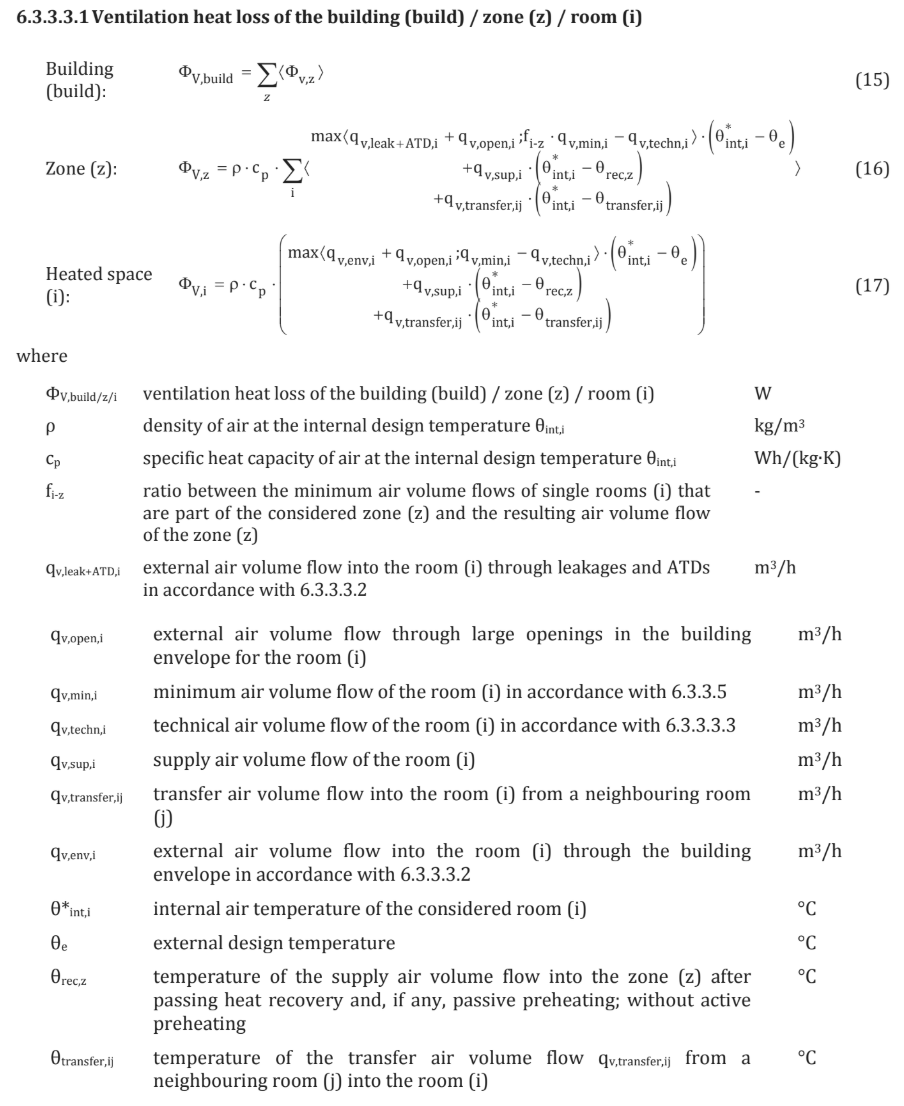
This is because some of the air flow into a room may be pre pre-warmed from another room. Rooms facing the wind may have cold outside air pushed into them, but then the warm air from those rooms will flow into other internal roomsrooms. therebyThis reducingreduces the amount of cold air entering a room not facing the wind.wind, Soso not all warm air is lost to the outside. This then reduces the overall ventilation heat loss for the building compared to the individual rooms, typically by half as the total zone ventilation loss is multiplied by volume flow ratio of 0.5.rooms.
A zone is a group of rooms that are air-connected by design, such as by an internal door that complies with the requirements in Approved Document F: Ventilation, Volume 1 – Dwellings. Homes are commonly single ventilation zones and Heatpunk assumes a building represents a single ventilation zone. Whichever method is selected for specifying the air permeability, the BS EN 12831-1:2017 ventilation loss equations will yield the maximum of these two values: Read below for the various assumptions made for the standard and measured air permeability Where a measured air permeability is not known, the whole-building infiltration rate is assumed based on the minimum ventilation rate required for the number of bedrooms in the property. This data is derived from CIBSE Domestic Heating Design Guide (2021) Table 1.7. The ventilation rate (in L/s) is then converted to a whole-house air change rate (ACH or 1/h) based on the combined internal air volume of all rooms. The When the building air permeability has been measured, Heatpunk will apply a minimum air change rate of 0.5 ACH to all rooms. This minimum air change rate for habitable rooms is taken from Table B.7 of BS EN 12831-1:2017 and will replace the default values from Table 3.8 of the CIBSE Domestic Heating Design Guide (2021). This approach is intended to more accurately represent the actual air permeability of the building as measured. This may result in lower ventilation heat loss figures than using fixed default air change rates. Fixed default air changes rates can lead to a significant over estimation of ventilation heatloss, especially in older buildings. You can choose to override the minimum air change rate of 0.5 ACH. Increasing the ACH for a room will only affect its ventilation loss if the ACH yields a larger loss than the loss computed using the measured air permeability. What is a zone?
Ventilation losses can be calculated using either the standard method or using a measured air permeability test input.
Air change rates
rate.rate.room air change rates.
Historically, room air change rates.
were
keyHow
inputsdoes this impact my designs?
calculations.The However,room nowventilation losses are not discounted by the airvolume changeflow basedratio loss valuethat is comparedapplied to the lossbuilding computedas usinga whole.Calculation assumptions
ormethods. assumed ventilation rate based on expected occupancy. The ventilation loss is the greater of the two values.
assumptions
Standard method
When
thisstandard method is used, Heatpunk will apply the default air change rate values from Table 3.8 of the CIBSE Domestic Heating Design Guide (2021). The BS EN 12831-1:2017 ventilation loss equations will then yield the maximum of these two values:
The loss computed using the assumed ventilation rate.
The loss computed using the room air change rates.
Using the CIBSE fixed default air change rates may result in higher ventilation heat loss figures than using the estimated ventilation rate based on expected occupancy, especially in older buildings. In some cases, you may choose to override the default air change rates.
assumptions
airtightnessair-tightness of the building can be tested using the methodology outlined in CIBSE TM23. The result is expressed in m³/m².hr at a specific pressure difference of 50Pa.Byusing
Heatpunk, you are acknowledging and accepting this methodology.
By using Heatpunk, you are acknowledging and accepting this methodology.
How does this impact my designs?
Heat pump sizing: Heat pumps are sized tomeet the overall heat loss for the building. The ventilation losses for the building are generally half the sum of the individual room ventilation losses.Heat emitter sizing: The emitter for an individual room mustmeet the worst case ventilation heat loss. The room ventilation losses are not discounted by the volume flow ratio that is applied to the building as a whole.
Legacy method
MCS certification in accordance with MIS 3005-D now requires heat loss calculations comply with BS EN 12831-1:2017. Please only select this method when viewing old projects.
This method is based on BS EN 12831:2003. This calculation is simply a sum of the individual ventilation losses of each room. For each room the following calculation is done:
Room ventilation losses = 0.33 * ACH * Volume * Temperature difference,
where the ACH was taken from Table 3.8 of the CIBSE Domestic Heating Design Guide (2021).